Turning low ambient temperatures into saving

Improving the performance of systems in industrial and commercial facilities is rightly a priority for companies. Energy prices are high, a reality that is becoming increasingly uncomfortable. This is more than just a statistic. Combined with other market data, this translates into daily operational problems. The prospect of researching and implementing energy-efficient upgrades, decarbonizing operations, or simply replacing older temperature control equipment can be daunting.
Cooling and heating are of crucial importance in all production processes and the indoor climate. They have a direct impact on operational efficiency, lead times, product quality, and staff productivity. These systems are essential for every production application, from the food and beverage industry to plastics manufacturing, and should not be ignored or taken lightly.
Due to high electricity costs and increasing pressure to reduce environmental impact, the use of outdated, inefficient systems that do not align with the latest technological developments constitutes a continuous operational risk. This poses a threat to margins, uptime, and reputation. Manufacturers facing higher bills, unpredictable demand, and a tight labor market need solutions that offer immediate efficiency, reliability, and long-term flexibility.
By utilizing the full potential of a process cooling system, savings can be realized and operational efficiency improved. However, this requires a lifecycle approach, looking at opportunities to reduce total system costs throughout the entire lifecycle, rather than focusing solely on the initial investment costs.
The concept of free cooling is far from new. In the past, we cooled cars heated by the sun simply by opening the windows, allowing cooler outside air to lower the temperature inside. The same principle applies to free cooling in industrial environments.
Any company or organization with an externally located chiller can benefit from free cooling. When the outside temperature is low enough to cool the process fluid without the need for mechanical cooling from the chiller, a free cooling solution can be introduced. This can take the form of partial free cooling, where the chiller’s compressors continue to contribute to the cooling, or full free cooling, where the chiller’s load is fully compensated. By comparison, a chiller without free cooling must operate continuously to achieve the same cooling effect.
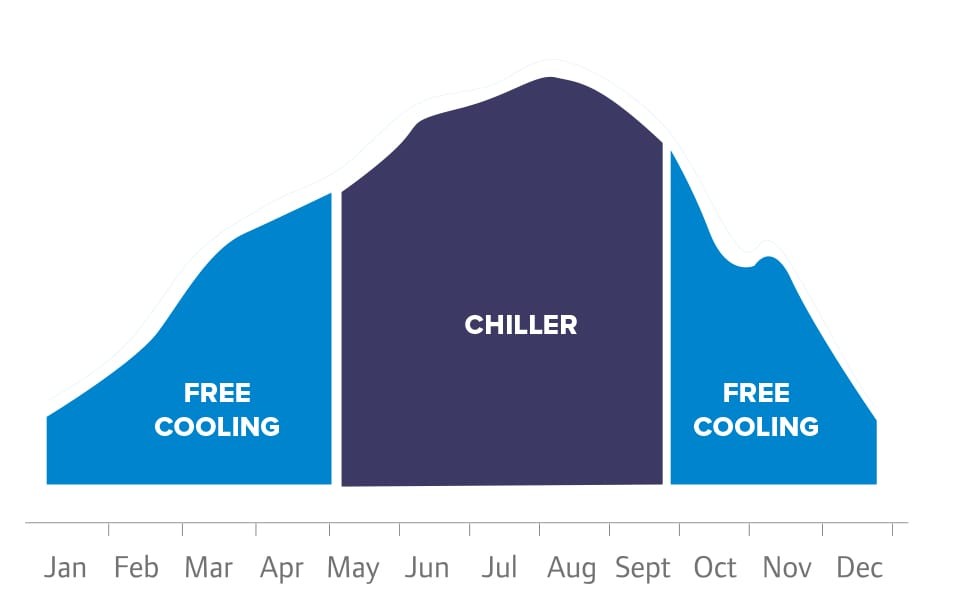
In a large part of Western Europe, the relatively cool climate and low ambient temperatures make it possible to make partial or full use of free cooling for a large part of the year. This results in significant energy savings, particularly between October and April, where electricity savings can in some cases reach up to 80%.
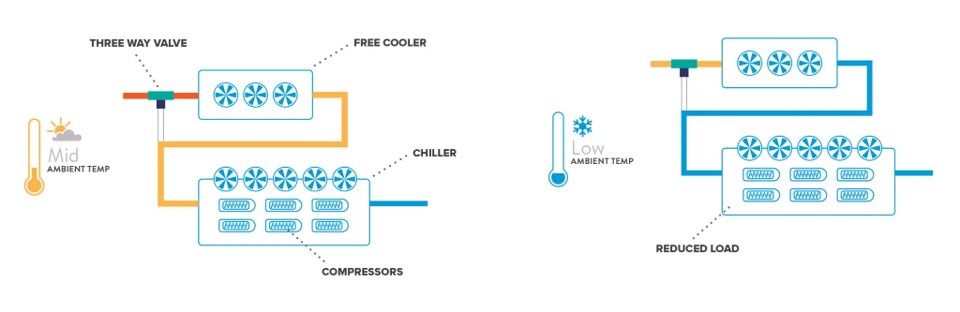
When the ambient temperature drops just one degree Celsius below the return temperature of the process fluid, a three-way valve diverts the returning process fluid through the free cooling coil. In this coil, the cooler ambient air extracts process heat and cools the fluid. This is known as partial free cooling. The fluid then flows through the evaporator of the chiller to reach the required set temperatures. This relieves the load on the chiller components and extends their service life. Full free cooling is achieved when the ambient temperature continues to drop and the fluid from the free cooler meets the required process temperature.
Free cooling can be implemented with a chiller featuring an integrated free cooling coil or with an external free cooler operating in series with the chiller.
Free coolers can also be used as a standalone cooling solution or to provide free cooling for a significant portion of the year in combination with a chiller.
Since these systems are fully assembled, with integrated controls, three-way valve and actuator, and bypass piping, they can be easily installed in both existing systems and new construction. Furthermore, no communication is required between the free cooler and the chiller, allowing chillers to be switched off for up to 90% of the year in typical process cooling systems.
Solutions are available with multiple fixed fan speeds, frequency converters, and electronically commutated (EC) fans to meet various noise requirements. The unit control panels are designed for ease of use, offering a true plug-and-play experience and connectivity. They can be configured to meet individual project requirements, such as low noise levels, space constraints, and aesthetics. They can also be integrated into building management systems (BMS).
In summary, free cooling offers a concrete solution for reducing mechanical energy consumption, lowering CO2 emissions, and minimizing the load on mechanical components. As a result, free cooling reduces maintenance costs and extends the lifespan of cooling equipment. In the case of chillers, a lower load can also limit depreciation over the unit’s lifespan. Free cooling is easy to retrofit (space permitting) and can yield a quick return on investment for new equipment.
Customers who wish to integrate free cooling into their systems but want to avoid large investments can utilize rental options or equipment-as-a-service offerings, where customers receive a predictable monthly subscription. This type of flexible, subscription-based agreement offers access to the latest temperature control technology, maintenance, and equipment replacement or upgrades. All this with the flexibility of a fixed operating cost. The flexibility of this business model can play a crucial role in decision-making and in the transition to more sustainable cooling.
Make a selection for other news items below.

The high-performance industrial process cooling from the Italian manufacturer MTA is a household name in the market. In…
Anyone thinking of propane when it comes to the Aries is right, but that is the Aries N.…
Our experts are ready to provide you with tailored advice.